Methylene Blue Dosage Guide: How Much Should You Take? Methylene blue has been used and studied in medicine for over 140 years, the last few years, it has become an exciting topic in the bodyhacking community. But the question of how much to take is one that confuses a lot of first-time users. Searching online and you'll find recommendations ranging from 1mg to over 100mg — a range so wide it's essentially useless. The research tells a much more specific story. We explain why we chose 10mg as our dosage in our supplements at the end of this article.
Here's what the science actually says. The Hormetic Dose-Response: Why More Is Not Better The most important concept to understand about methylene blue is hormesis — the phenomenon where a compound has beneficial effects at low doses and harmful (or opposite) effects at high doses. This isn't a fringe idea. It's been documented extensively in the peer-reviewed literature. A landmark 2012 review by Julio C. Rojas and Francisco Gonzalez-Lima at the University of Texas at Austin, published in Progress in Neurobiology, described methylene blue's hormetic profile in detail: "Methylene blue shows a hormetic dose-response, with opposite effects at low and high doses. At low doses, methylene blue is an electron cycler in the mitochondrial electron transport chain, with unparalleled antioxidant and cell respiration-enhancing properties." — Rojas JC, Bruchey AK, Gonzalez-Lima F. Neurometabolic mechanisms for memory enhancement and neuroprotection of methylene blue. Prog Neurobiol. 2012;96(1):32–45. PMID: 22067440 The practical implication: the therapeutic window is real and narrow. Below it, you get little effect. Above it, you can actually impair the very functions you're trying to enhance.
What the Research Identifies as the Effective Range. The most-studied low-dose range in human and animal research is 0.5–4 mg/kg of body weight. For a 150-pound (68 kg) person, that translates to roughly 34–272 mg of methylene blue. The lower end of that range — around 1–2 mg/kg — is where most of the cognitive benefit studies have been conducted. The landmark human neuroimaging study, published in Radiology in 2016 by Rodriguez et al. at UT Health Science Center San Antonio, used a dose of approximately 280 mg (4 mg/kg for a 70 kg adult). In a randomized, double-blinded, placebo-controlled trial of 26 healthy adults: Methylene blue increased fMRI activity in brain regions involved in sustained attention (bilateral insular cortex) It increased fMRI response during short-term memory tasks (prefrontal, parietal, and occipital cortex) Participants showed a 7% increase in correct responses during memory retrieval (P = .01) — Rodriguez P, Zhou W, Barrett DW, et al. Multimodal Randomized Functional MR Imaging of the Effects of Methylene Blue in the Human Brain. Radiology. 2016;281(2):516–526. PMID: 27351678
What Happens Above the Therapeutic Range? At doses above approximately 2–4 mg/kg, methylene blue begins to inhibit the same mitochondrial complexes it was previously enhancing. The 2012 Rojas/Gonzalez-Lima review notes that high-dose methylene blue "has opposite effects" compared to low-dose — impairing memory and cellular respiration rather than supporting them. At very high doses (>10 mg/kg), methylene blue can cause methemoglobinemia — a condition where hemoglobin loses its ability to carry oxygen effectively. It's worth noting that methylene blue is itself the FDA-approved treatment for methemoglobinemia at low doses (1 mg/kg IV), which illustrates just how dose-dependent its effects are. The 2022 review by Bužga et al. summarizes: "The toxic effects of the application of MB are dose-dependent and include serious symptoms such as hemolysis, methemoglobinemia, nausea and vomiting." — Bužga M, et al. Methylene blue: a controversial diagnostic acid and medication? PMC. 2022. PMC9618115
The Blue Urine Question One of the most common concerns first-time users have is the blue or blue-green urine that can occur after taking methylene blue. This is normal, harmless, and dose-dependent — it occurs because methylene blue is excreted through the kidneys and interacts with urochrome, the yellow pigment naturally present in urine. At the low doses used for cognitive support (10–30 mg), urine discoloration is mild or absent for many people. At higher doses, it becomes more noticeable. It resolves completely as the compound clears your system.
Personally, I have found that 10mg, or one bottle of Cogniblu, does slightly taint my urine, on days when I take two bottles of Cogniblu I definitely notice the coloration. We have found that clients find it comical to be on the blue urine team. I have also found that depending on how much water I consume, it dilutes the coloration.
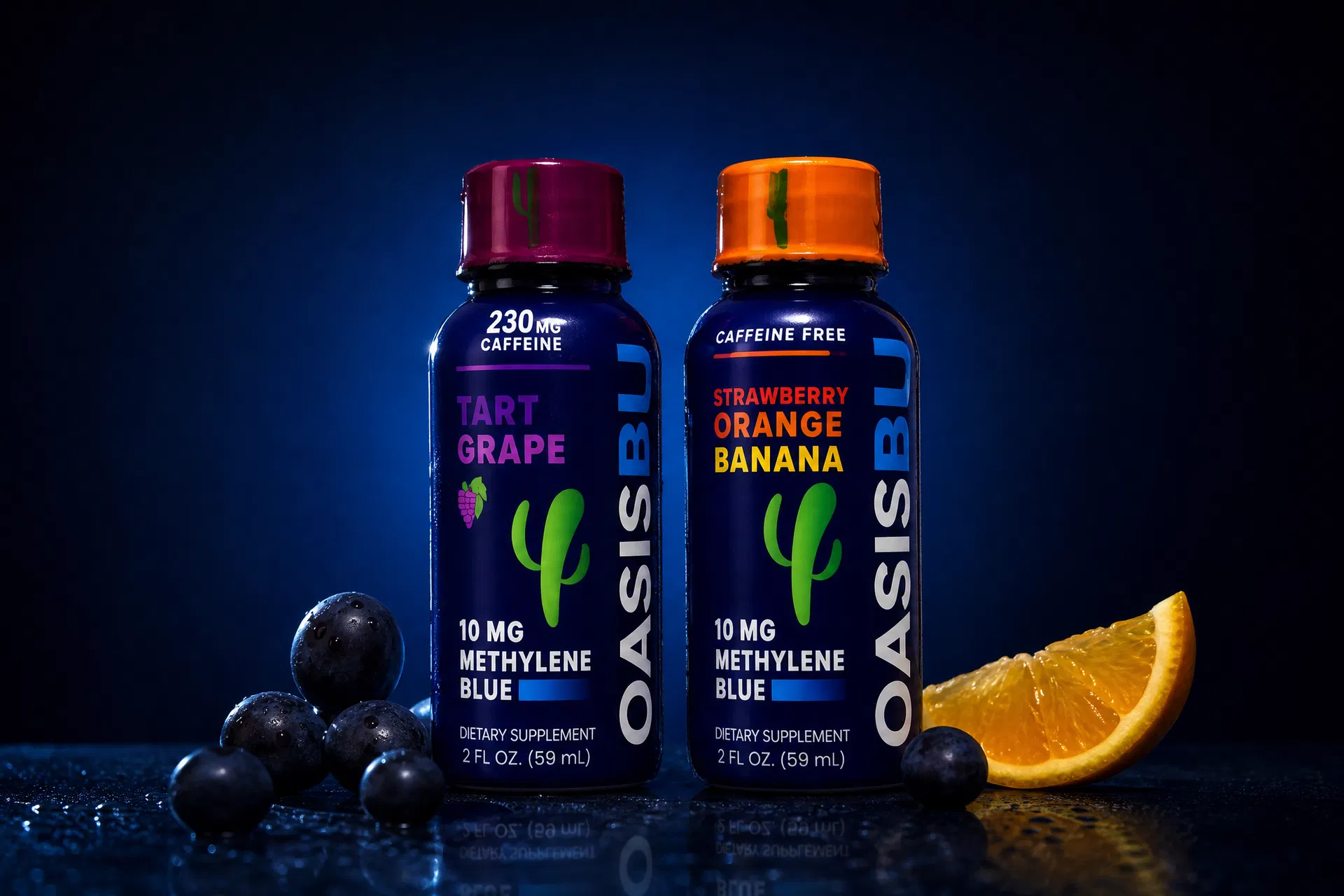
Where Does 10mg Fit In? Cogniblu contains 10mg of USP-grade methylene blue per 2oz shot. For a 150-pound person, that's approximately 0.15 mg/kg — well within the low-dose range where the research shows beneficial effects on mitochondrial function and cellular energy production.
When we were originally testing and formulating Cogniblu, we spoke with our lab who produces our Methylene Blue and they felt with their testing and consumer discussions that 10 to 12mg was a perfect starter dose for a new client. We also have a clinical division that specifically doses on a private label basis for clients that wish a specific dosage at another level. One client has both 10 and 20mg versions available post MB IV infusion for take home clients. This dose is consistent with the approach described in the Rojas/Gonzalez-Lima review, which notes that even sub-milligram-per-kilogram doses have demonstrated measurable effects on cytochrome c oxidase activity — the mitochondrial enzyme central to methylene blue's mechanism of action.
Who Should Not Take Methylene Blue? The most critical contraindication is concurrent use with serotonergic medications — SSRIs, SNRIs, and MAOIs. Methylene blue inhibits monoamine oxidase A (MAO-A), and combining it with drugs that raise serotonin levels can cause serotonin syndrome. This interaction is well-documented in the clinical literature and has been flagged by the FDA. Read the FDA safety communication here.
If you are on any SSRI, SNRI, or MAOI, speak to your doctor before taking methylene blue. People with G6PD deficiency, pregnant or breastfeeding women, and those with kidney or liver disease should also consult a physician first. We'll cover the full side effect and contraindication picture in a dedicated article — but the SSRI interaction is the one that matters most for most people.
A Practical Summary
| Dose Range | Effect |
|---|---|
| 0.5–4 mg/kg (~35–280 mg for a 70kg adult) | Studied therapeutic range; cognitive and mitochondrial benefits |
| 10–30 mg (0.15–0.44 mg/kg) | Low-dose supplemental range; mitochondrial support |
| >4 mg/kg | Diminishing returns; potential for opposite effects |
| >10 mg/kg | Risk of methemoglobinemia and other adverse effects |
The research consistently points to the same conclusion: low-dose methylene blue, in the 0.5–4 mg/kg range, is where the benefits are. Higher doses don't amplify the effect — they reverse it. The Bottom Line
If you're new to methylene blue, start low. The 10mg dose in Cogniblu is a reasonable entry point — it's within the studied low-dose range, it's USP-grade (pharmaceutical purity), and it's delivered in a format that makes consistent daily use practical.
As with any supplement, pay attention to how your body responds. And if you're on any serotonergic medication, have a conversation with your doctor before adding methylene blue to your routine. I take Methylene Blue in Cogniblu form on a daily basis since I found it about 2 years ago. I truly feel the difference it makes and I am proud of what we have built. Delicious Juice based products that deliver your Methylene Blue, it just made sense to me. I love the energy and the mental clarity that I feel when I take this product. I was never a fan of the metallic taste of straight Methylene Blue and I feel my team really knocked it out of the park on this one. Give it a shot and let us know what you think.
This article is for informational purposes only and is not medical advice. Cogniblu is a dietary supplement. These statements have not been evaluated by the FDA. This product is not intended to diagnose, treat, cure, or prevent any disease.
Sources: Rojas JC, Bruchey AK, Gonzalez-Lima F. Neurometabolic mechanisms for memory enhancement and neuroprotection of methylene blue. Prog Neurobiol. 2012. https://pubmed.ncbi.nlm.nih.gov/22067440/ Rodriguez P, et al. Multimodal Randomized Functional MR Imaging of the Effects of Methylene Blue in the Human Brain. Radiology. 2016. https://pubmed.ncbi.nlm.nih.gov/27351678/ Ramsay RR, et al. Methylene blue and serotonin toxicity. Br J Pharmacol. 2007. https://pmc.ncbi.nlm.nih.gov/articles/PMC2078225/ Bužga M, et al. Methylene blue: a controversial diagnostic acid and medication? PMC. 2022. https://pmc.ncbi.nlm.nih.gov/articles/PMC9618115/